
How to Integrate a Water Feature into an Existing Landscape
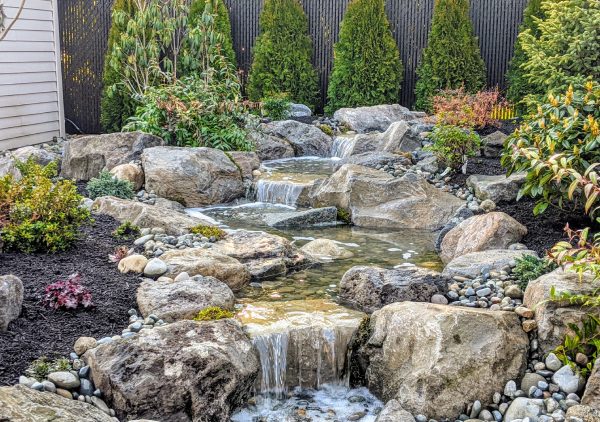
At Fontana Ponds & Water Features, we know that, when you’ve spent years cultivating a garden you love, the last thing you want is a pond that sits in the middle of it like a stranger at a dinner party. The good news is that integrating a water feature into an existing landscape isn’t about working around what you have.; it’s about letting what you have do half the work for you.
Start With a Genuine Site Assessment
Before anything else, the existing landscape needs to be read carefully. This is where the best design decisions happen.
A few things we look at closely:
- Sun and shade patterns: Aquatic plants need adequate sunlight to thrive. Too much shade limits your plant palette; full sun increases algae pressure and evaporation. Understanding your yard’s light throughout the day shapes placement significantly.
- Tree proximity: Mature trees are beautiful near water features, but root systems can threaten liner integrity, and deciduous trees create a seasonal leaf management commitment. Established cedars and firs common in BC yards behave very differently than deciduous species.
- Natural grade and drainage: Existing slopes are opportunities. A gentle grade that already moves water toward a corner of the property is the beginning of a natural waterfall. Low spots that collect water during Pacific Northwest rainfall can anchor a pond design.
- Utilities: Electrical, gas, and irrigation lines need to be located before excavation begins.
- Viewing angles: Where do you spend time? The kitchen window, the patio, a reading corner? The feature should be oriented toward those moments, not just positioned where it’s easiest to build.
Learn how to create a balanced ecosystem pond.
Leverage Your Existing Landscape as an Asset
Mature gardens aren’t constraints. Established trees offer immediate canopy that softens the edges of a new feature. Garden beds that have filled in over the years give you a ready-made framework for extending plantings to the water’s edge. Existing hardscape reduces your overall project scope.
When we design for a retrofit, we’re looking for the landscape’s existing visual logic and working within it.
Proportion and Scale
A water feature that’s too small disappears. One that’s too large overwhelms. The right scale feels continuous with the rest of the space, not inserted into it. Using existing shrubs, trees, or garden borders as natural boundaries for the water feature zone creates that sense of intention.
Making the Connection Feel Natural
The difference between a feature that looks added and one that looks inevitable comes down to a few deliberate choices:
- Echo existing materials: If your garden already uses river rock or natural stone, carry that into the waterfall edges and surround.
- Bridge with plantings: Extend existing bed lines toward the water. Moisture-loving versions of plants already in your landscape create visual continuity between the established garden and the new feature.
- Connect with pathways: A water feature reached by extending an existing path feels purposeful. One that requires a trip across open lawn feels like a detour.
- Match the grade: Excavated soil needs to be managed carefully. The “volcano effect,” where excavated material creates unnatural mounding around a feature, is one of the most telling signs of a poorly integrated installation.
The Case for Pondless Waterfalls in Retrofit Situations
In yards where space is tight or the layout is irregular, pondless waterfalls often offer more flexibility than traditional ponds. They tuck naturally into narrow side yards, shaded corners, or the edge of an existing patio without requiring the open footprint a full pond demands. The sound and movement are fully present; the spatial requirement is much reduced.
What Installation Actually Looks Like
This is where homeowners with established gardens often have the most anxiety, and it’s worth being direct about it.
Professional installation involves equipment. There will be some disruption. What separates a careful installation from a damaging one is planning: dedicated access routes, equipment mats to protect lawn and beds, and clear staging areas for excavated material. Perennials can be relocated temporarily and replanted. Most survive transplanting if timed well, with spring and fall being significantly less stressful on plant material than midsummer heat.
Construction on a residential water feature typically wraps up in under a week. The immediate aftermath often calls for some refreshing of the surrounding areas, including mulch, minor re-grading, and plant additions, but the core landscape remains intact.
As an Aquascape certified contractor, we follow installation protocols built specifically for real-world residential landscapes, where protecting what’s already there matters as much as building what’s new.
The Feature Finds Its Place Over Time
A newly completed water feature will look new. The integration continues through the first growing season as aquatic and marginal plants establish, stone begins to weather, and the surrounding garden adjusts to its new element. Wildlife finds the feature. The water develops its own ecology. Within one full growing season, most features stop reading as additions and start reading as destinations. True maturity, where the plantings are full and the materials have developed their patina, takes a couple of years. It’s worth the wait.
Bring Your Landscape to Its Next Chapter
If you have an established garden and have been imagining how a water feature might complete it, we’d love to take a look together. Our complimentary consultation includes an assessment of your existing landscape so we can see exactly where the opportunity is. Reach out to our team at 778-990-9773 to get started.


Your Oasis...
Our Passion
Mission, BC V2V 7G9
(C) 2026 Fontana Ponds & Water Features | Privacy Policy