
How to Plan a Water Feature for a Sloped Backyard
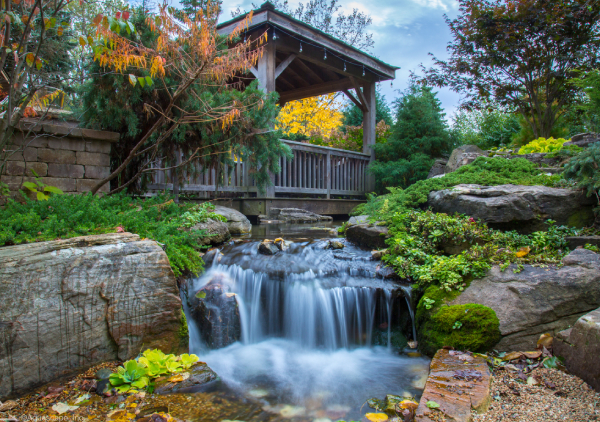
At Fontana Ponds & Water Features, we work with sloped backyards constantly, and the homeowners who come to us most often arrive thinking their terrain is a problem to solve. It isn’t. When you plan a water feature for a sloped backyard, the grade you’ve been working around can become the very thing that makes your outdoor space extraordinary. Elevation change is what gives water movement, sound, and drama. A flat yard has to borrow those qualities. A sloped yard already has them.
Why Slopes Are an Asset, Not an Obstacle
Gravity does the work that flat-yard installations have to engineer around. A natural elevation change means water flows downhill with real momentum, creating richer, more layered sound than a single-level feature can produce. Pump systems work with the grade rather than against it, which pays off in efficiency over time. Multiple viewing angles emerge naturally as the feature follows the contour of the land. The result looks like it belongs there, because it does.
The challenge isn’t the slope itself. It’s understanding which feature type suits the grade, and how to plan the installation so the water behaves exactly as intended.
Learn more about how to integrate a water feature into an existing landscape.
Reading Your Slope Before You Design
Not all slopes are equal, and the degree of your grade shapes every design decision that follows. Before settling on a feature type, it’s worth understanding a few key characteristics of your terrain.
Gentle grades offer the most flexibility. Ponds, pondless waterfalls, and meandering streams all work beautifully, and you have real latitude in how the composition takes shape. Moderate to steep grades are generally best suited to pondless waterfalls and cascading stream systems, where water disappears into a buried reservoir rather than pooling in a traditional pond basin.
Water already has a path through your yard. Identifying where runoff naturally collects and where it exits the property informs where a feature should sit and how it should be oriented. A well-placed water feature can work with your existing drainage rather than adding to it.
Soil and foundation conditions matter too. In the Fraser Valley, rocky or clay-heavy soils are common. These affect how features are anchored and excavated, and they influence liner placement to ensure water doesn’t escape laterally down the slope.
The Best Water Feature Types for Sloped Properties
Pondless Waterfalls
For most sloped properties, a pondless waterfall is the most practical and visually compelling choice. Water cascades down the slope and disappears into an underground reservoir, eliminating the overflow and maintenance concerns that come with an open pond on uneven ground. The sound is full and immediate, the visual is clean, and the safety profile is ideal for households with children or pets.
Cascading Streams
A stream system traces the natural path of the slope, winding through plantings and stone in a way that makes it feel like it was always there. This option rewards a longer, more gradual grade and pairs beautifully with layered native plantings at varying elevations.
Terraced Ecosystem Ponds
A more ambitious design for properties with pronounced grade changes: multiple pond basins connected by waterfalls or short stream runs. Each level functions as its own ecosystem, and the overall composition creates a destination rather than a single focal point.
Traditional Ponds
Best placed at the base of a slope where the terrain naturally levels, a traditional pond takes advantage of the visual backdrop above while keeping the water table stable. On steeper properties, this usually requires some grading work to establish a level basin area.
Technical Planning Considerations
A few specifics that distinguish sloped installations from flat-yard projects are worth understanding before construction begins.
Pump placement matters more than most people expect. The recirculating pump belongs at the lowest point of the system and needs to be sized to push water back to the feature’s highest point, accounting for the full vertical rise.
Liner integrity is equally critical. On a slope, water will find any lateral escape route, so edges must be secured against the grade to keep water in the feature rather than migrating through the surrounding soil.
Equipment access is something to think through early. Steep grades sometimes require planning around how machinery enters the site during construction, and that conversation is much easier to have before a design is finalized.
Winterization rounds out the list. Sloped features need to drain completely during winter shutdown to prevent ice damage in the lines and reservoir. Proper planning at the design stage makes seasonal maintenance straightforward rather than complicated.
Designing for the Long View
The best sloped water features look like they grew there. That means following the natural contours rather than imposing a shape the terrain doesn’t support, using stone that reflects the existing landscape, and planting along the feature’s edges to soften the transition between structure and yard.
Sightlines are something we think carefully about from the start: from the kitchen window, from a patio seating area, from the upper part of the yard looking down. A well-designed cascading feature rewards you from multiple vantage points, and that’s something a flat-yard installation rarely achieves.
As Aquascape Certified Contractors, we build every feature as a complete ecosystem, balanced, low-maintenance, and designed to look better over time as plantings establish and the water clarifies naturally.
Ready to See What Your Slope Can Become?
If you’ve been sitting with a sloped backyard and wondering what’s possible, we’d love to walk your property with you. At Fontana Ponds & Water Features, our complimentary consultations are about understanding your specific terrain and showing you what it can hold. Reach us at 778-990-9773 to start the conversation.


Your Oasis...
Our Passion
Mission, BC V2V 7G9
(C) 2026 Fontana Ponds & Water Features | Privacy Policy